Showing posts with label 2015. Show all posts

Tuesday, December 22, 2015

YWAA: 2015 in Review

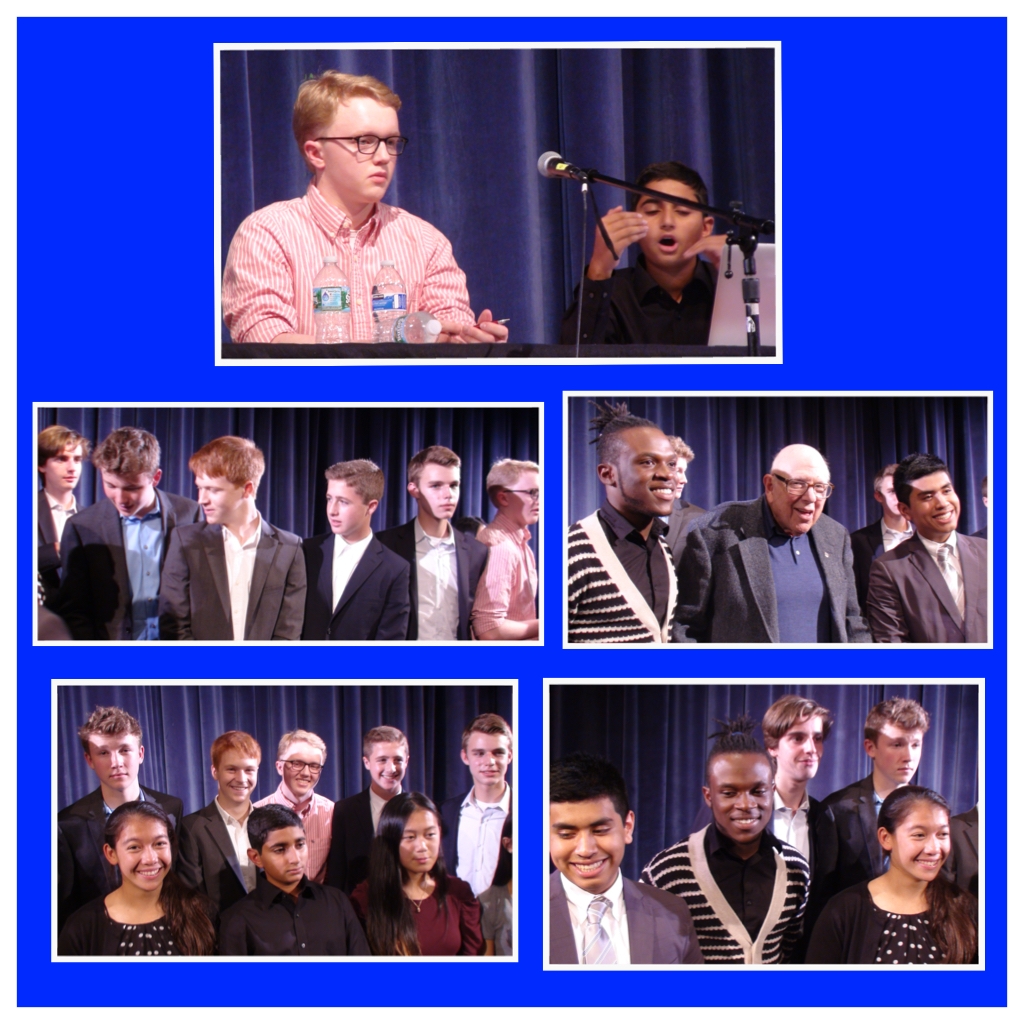
If it's November at YWAA, it's debate time. Yale's team defeated the Princeton duo in Armonk in 2015. (YWAA photos)

Happy holidays! Before bells are rung and songs are sung to ease ourselves out of 2015, let's review the year in a Yale Westchester way:

The year was again filled with events, speakers, days of service, admissions interviews, music, art, history, exploits on athletic fields, alumni engaged in communities, and students impressing elders with astounding levels of achievement.

Community Service

Susan Kaminsky '86, YWAA board member, again led Yale Westchester in the annual Yale Day of Service in May, when alumni, families and friends spent a weekend doing something beneficial in the community.  YWAA sponsored volunteer activities at Ward Pound Ridge in Cross River, William Holmes Elementary School in Mount Vernon, SPCA of Westchester in Briarcliff Manor, the Sustainable Garden Program in Scarsdale, and at Garrison Union Free School in Garrison.

Maggie Favretti '85 again coordinated in Scarsdale, where alumni and friends cleaned the garden at Scarsdale High School.  Regina Possavino '01 returned with her group to tidy up the entrance to the Ward Pound Ridge Reservation, New York State's largest park. Kaminsky led volunteers at the SPCA of Westchester.

At the Holmes School in Mount Vernon in a return visit, Kaminsky arranged for alumni and community leaders to speak to students about careers. Speakers offered career advice about public safety, marketing, physical fitness, television production, architecture, law and even animation.

Eager students asked questions, waved their hands to ask more, and added amusing commentary. One made a special request to architect Garrett Omoto '08MArch. to redesign his school with swimming pools and tennis courts. Liz Massie '86, a Discovery Communications executive, recounted her many roles in television.

The year marked the 16th time the Cecil family awarded the "Jandon" college scholarships to Westchester students. The awards, named for Don Cecil '47 and his wife Jane (Jane + Don = "Jandon"), amount to about $10-12,000 per student and are based on academic achievement and financial need. Westchester County administers the program and selects the winners.

Students in Mount Vernon listened to Yale alumni and others talk about careers from architecture to television production. (YWAA photos)
A Capella Singing in Rye and Scarsdale

Ask Yale students and alumni what college boasts the best in a cappella singing, and unless they spent their four years hiding in the darkest corners of the Sterling stacks, they will say Yale--from the Whiffenpoofs to the Spizzwinks (?) and Red, Hot, and Blue.

The latter two groups performed in Westchester during the year.  The Spizzwinks (?) have made Westchester a favorite stopping point on the way to other exotic locales, having performed in at least three concerts in the area the past two years.

Bill Nightingale '53 organized a music event in December in Rye and invited Yale's oldest co-ed group Red, Hot and Blue.

B.K. Munguia '75 and Regina Possavino '01, YWAA board members, invited the Spizzwinks (?) to be the featured performers at a concert in Scarsdale in April. The group sang unique arrangements of "Let It Be" and "Heard It Through the Grapevine."

The Spizzwinks (?) returned to Westchester in December to celebrate Founding Father John Jay's 270th birthday at the Jay Heritage Center in Rye, where Suzanne Clary '83 is president.  Mason Rees '76, a former Spizz singer, joined them for "Blue Skies."

The Spizzwinks (?), like many Yale singing groups, are always coming and going.  They had just returned from South America when they sang in Scarsdale.  They are headed to Boston during Yale's holiday break.
In debate in 2015, Yale and Princeton squared off in Armonk, while Harvard opted to remain at home. (YWAA photos)

Debate in Armonk

Yale and Princeton sparred in the annual Westchester debate competition in November in Armonk. Teams from the two schools braced themselves to handle a challenging topic:

Should freed slaves (in the years after slavery) be awarded land grants from the federal government as reparation?

Yale and Princeton alumni, high-school students and teachers on hand, and parents waited to see how the debate squads would treat the subject.  Yale was asked to argue in favor of such grants and did so adroitly. After giving participants a few minutes of feedback, judges pronounced Yale the winner over Princeton.  Sam Feinburg '18 and Walker Mayer '18 competed for Yale.

The debate competition is funded in part by the Bill Nightingale '53 Fund. Richard Bradley '86 was the evening's emcee. Nightingale himself and Susan Kaminsky '86 helped organize the event. Six high-school teams competed after the Yale-Princeton match-up, debating other topics. A Byram Hills team won the high-school round.

Yale Professor Joanne Freeman amused the Jay Heritage Center audience in December with colorful anecdotes from the 1790's. (Jay Heritage Center photos)

Lectures in Rye

A YWAA tradition invites Yale professors to Westchester to speak on subjects for which they are world experts and share views on topics that cover just about anything taught within Yale's Gothic walls-- history, political science, medicine, music or physics.

In 2015, AYA sponsored two short courses in YWAA's backyard.  Yale professors taught alumni-college classes in Rye. Yale Medical School Professor Meir Kryger lectured on sleep problems in a series of lectures in March and April. Yale School of Music Professor of Opera  Judith Malafronte taught a class on Shakespeare, Verdi, and opera in October and November.

In December, Yale history Professor Joanne Freeman swept her audience back in time to the 1790's and early 1800's and told stories about a new U.S. government jostling to get it right, often resorting to "dirty politics." Early politicians were desperate to establish their reputations and proper places in Congress or in the Executive branch.

Freeman, a guest lecturer at the Jay Heritage Center in Rye, had audience members on seat edges and thrilled them with anecdotes that involved familiar names in American history:  Jefferson, Hamilton, Washington, and Madison. The Founding Fathers in the early days, Freeman said, were sometimes "making it up as they went along."

Shakespeare at Boscobel

Bruce Jennings '71, past president of YWAA, kept alive a favorite YWAA summertime activity--the annual Yale outing at Boscobel, featuring updated performances of Shakespeare under the big, white tent and the pre-performance lecture from Yale Professor Murray Biggs. Biggs kicks off the afternoon with helpful explanations of what alumni and their guests are about to see.

Each year, once or twice during the summer, Yale alumni and friends join Jennings to enjoy the expansive, shoreline vista of the Hudson River before congregating for Shakespeare nearby. This year, Biggs lectured on The Winter's Tale before the Yale contingent, along with hundreds of others, saw the evening performance.

Unfortunate for YWAA, Jennings , after years of leading Boscobel and contributing to Yale Westchester in innumerable ways, relocated to Nashville in late 2015 (and assumed a post in bioethics at Vanderbilt). YWAA plans to keep the Boscobel tradition vibrant.

In April, Debra Johns from Yale's admissions office accompanied students to Bronxville for the annual Westchester reception for admitted students. YWAA and ASC Director Bill Primps '71 hosted. (YWAA photos)

Westchester Admissions

Dozens of Yale Westchester alumni are involved in admissions. They speak to students interested in Yale, conduct interviews in all parts of the county, and coax admitted students to choose Yale.

Application numbers at Yale now hover about the 30,000 mark.  About 300 or so are Westchester candidates, most of whom are interviewed under the Alumni Schools Committee program, directed in Westchester by Bill Primps '71.  About 10 percent of Westchester applicants are invited to join the freshman class on Old Campus.

YWAA sponsored its annual admitted-students reception in Bronxville in April.  Debra Johns, a Yale admissions official who oversees Westchester, led a panel discussion with three Yale students to persuade admitted applicants to become members of the Class of '19. The Yale panel explained what makes Yale special. They said that includes "shopping period," two beloved weeks at the beginning of each semester, a Yale practice that has been around as long as anyone can remember.

What makes Yale special included, yes, the residential colleges and students' loyalties to the colleges for which they were randomly selected. And it includes the special projects they do with professors, the summers abroad, playing the tuba in the zany Yale band, and eating farm-to-table cuisine in Berkeley College.

This year's Westchester class included new students from familiar Yale-bound high schools (Scarsdale, New Rochelle, Hackley, Rye, White Plains, e.g.) and some Yale-every-other-year schools (Hastings, Ardsley, Mamoroneck, Kennedy, e.g.).

History and Arts

Four Yale alumni in the arts were honored by ArtsWestchester in April when the local arts group celebrated its 50th anniversary, citing 50 artists who live or work in Westchester.  Each received a $1,000 prize for their contributions and works.

Sidra Bell '01 of Greenburgh was honored for her innovative choreographer in her New York professional dance company.  Derek Bamel '89 was cited for music composition and clarinet performance.  Andrew Young '88MPhil. was noted for his work in film production and photography.  Chester Bicardi '76 '80MMus., a music professor at Sarah Lawrence, was recognized for his music composition.

The Merse-Kunhardt family in Chappaqua has had an unusual, intriguing legacy.  The family, since the late 1800's, accumulated the largest collection anywhere of artifacts and photographs from the Civil War era (over 70,000 items) and the largest collection of original photographs of Abraham Lincoln.

In 2015, the family decided maintaining the collection among family members in multiple storage places in Westchester had become a burden.  Eve Hart Rice '73, aware of  the family's plans to search for a permanent home, arranged for the family to donate the collection to the Yale Art Gallery and Beinecke Museum.

Yale will now house the vast collection, which includes well-known Lincoln photographs, including images used for Lincoln on the five-dollar bill, on the penny or at the Lincoln Memorial.

Alumni Notes

Franklyn Richardson '90MAR has presided over the Grace Baptist Church in Mount Vernon for 40 years.  The church celebrated his 40th this past spring and his years of service as pastor, not only to the church, but to the broader community.

The church is booming, thriving, and extends its impact into all parts of Westchester. Its membership exceeds 4,000.  Richardson, a past recipient of the Yale Outstanding Service Award, still maintains ties to the Yale Divinity School in recruiting, seminars and coursework.

Eve Hart Rice '73, YWAA board member and 2009 recipient of the Yale Medal, was elected to the Yale Corporation in May.  Rice also helped found YaleWomen, the national shared-interest group, for which she has served as Vice Chair. In Westchester, she previously served as president of the board of education in the Byram Hills (Armonk) school district and is married to YWAA president Tim Mattison '73.

Edgemont native Claudia Rosenthal '08 '14MMus. was selected as a finalist in January in the Metropolitan Opera National Council East Region competition.  Rosenthal studied art history and opera at Yale, was a featured performer at many productions in New Haven, and sang at the inauguration concert for Yale President Peter Salovey '86 Ph.d. in October, 2013.

Yale and AYA lost one of its most dedicated alumni leaders in 2015, when My Luu '96 died of a rare blood disease September 25, just weeks after getting married.  A Westchester resident, she was the current president of the Yale Alumni Association of New York.  She escaped war-ravaged Viet Nam at age 6 and found her way with her family to Texas, where she learned English, grew up to graduate valedictorian in her high-school class and win admission to Yale.

Luu said often she wanted to return favors to Yale, which opened its arms to her a few years after she risked her life fleeing her country on a boat.  She was an IBM executive in Westchester who found time to immerse herself in Yale alumni activity.  She help organized Yale's national Asian-American alumni group, as well.

One of her Yale friends told the New York Times in 2015 that Luu was a non-stop "organizer and connector," who was passionate about meeting Yale alumni and connecting them in various ways.

At The Game 2015, the results were the same. Harvard beat Yale. But there was a first. The late-afternoon television schedule forced the Bowl to install lights--at least for the time being. (YWAA photos)

Westchester Athletes

Westchester is not known to be a hotbed for grooming athletic talent for big-time college sports, but it has begun to send more athletes to play for (and study at) Yale in many sports.  Local preparation, competition and experience in fencing, cross country, lacrosse, basketball, baseball, and soccer have resulted in roster spots at Yale for Westchester students.

Matt Townsend '15 of Chappaqua was Yale's power forward on the men's basketball team that came within seconds of vaulting into the NCAA tournament for the first time in 53 years.  A heart-breaking loss at Dartmouth meant Yale had tied Harvard for the Ivy League championship. With Townsend contributing rebounds and occasional 15-foot shots, Harvard and Yale scratched and struggled in a play-off game in Philadelphia.

Harvard won the game (and went to the tournament). A distraught Yale took solace from this being the most exciting basketball season in ages.  Meanwhile, Townsend, a Rhodes Scholar, graduated, postponed his plans to attend medical school and is studying at Oxford this school term.

As athletics-inclined alumni know, Yale plays its games at Payne Whitney in the John J. Lee, Jr. '58 '59MEng. Amphitheater.  Lee, who lived in Larchmont until his death in 2001, ranks among the best ever in Yale basketball. He led Yale to a tournament berth in 1957, made 21 of 21 free throws in a game, and scored over 40 points against Harvard twice.

In January, 1957, Lee appeared on the cover of Sports Illustrated.  He was that good (20.3 ppg career average) and set a batch of team records, many of which were held until Scarsdale standout Butch Graves '84 arrived and broke them.

At Yale, Lee was known as "Johnny."  After Yale, Lee was "John," best known for his contributions to Yale in ways too numerous to count: Chair of Yale fund-raising campaigns, member of the Yale Corporation, Yale Medal recipient, and even an occasional ASC interviewer in the area.

In lacrosse in 2015, Yale won the Ivy League championship in May on the campus at Brown and with Bronxville's Owen Jones '18 as a member of the squad.

Westchester in 2015 proved a fertile ground for many high-school students venturing to Yale.  James Nicholas '19 of Scarsdale, arguably one of Westchester's best-all-around athletes in football, ice hockey and golf, decided to attend Yale to play football and golf.

Kumar Nambiar '19 of Mamaroneck, a lefty on the mound who was taught pitching mechanics by his mother, will play for Yale baseball this coming spring. Nambiar led Mamaroneck to a state championship, and many coaches and media members considered him the best pitcher in the area, if not state. Tim DeGraw '19, a highly regarded football receiver at Rye, will join Nambiar on the baseball team.

Many thought it would become a new, post-New Year, Harvard-Yale trend in Herald Square--The Game on Ice, Harvard vs. Yale in front of a huge crowd at Madison Square Garden in Manhattan.  In January, Yale whipped Harvard in men's ice hockey, 4-1, with 13,000 Yale and Harvard fans screaming at each other as if it were a November game at the Bowl.  Yale, national champion in 2013, had beaten Harvard the year before in the Garden before 15,000.

Was a new tradition born? As soon as a tradition was birthed, it was expunged. Organizers and athletic officials decided not to return to the Garden for a frozen version of Yale-Harvard in January, 2016.

In a new book that chronicles the 100-year history of the Yale Bowl, A Bowl Full of Memories, Westchester's Bill Primps '71 recalls scoring the winning touchdown at the 1969 Harvard-Yale game.  Primps, who had been a star player at Ossining High School, plunged from the two-yard-line for the only score in a 7-0 victory at the Bowl.

In November, Yale teased its large following at the Bowl in football at the 132nd Game against Harvard. Just as students settled into their residential-college sections, Yale scored, the Bulldog crowd shrieked, and the Bowl was abuzz. Could the Elis could snap Harvard's eight-game winning streak?  Harvard quickly seized the Game and won it, 38-19.

This Game was special, nonetheless, because lights were turned in the big blue oval for the first time. The second half glowed and players' helmets glistened. The crowd (what remained of the 51,000-plus) observed this break from tradition wasn't a bad idea, after all.

Ardsley's Fallon Sheridan '19 and Hastings' Sofia Griff '19 grew up playing soccer together in youth leagues.  They were deemed to be so good that, by late high school, they had skipped playing for their respective schools and were assigned to New York development leagues.

Both were recruited and admitted to Yale and were teammates on the women's squad this fall.  Right away, both played and started most games, and made a difference on the turf. (Griff scored 6 goals this fall; Sheridan had 2 assists.) Yale soccer stumbled often this fall (4-10-2 record). The Westchester pair, however, proved they will be team leaders in the seasons to come.

Merrell Clark

Ask Yale alumni in Westchester or alumni around the country about YWAA or Yale Westchester, and many will say Yale Westchester is Merrell Clark '57 '70MAR.  Or Merrell Clark is Yale and Westchester, wrapped in one, dedicated, eager, concerned and involved.

Clark, a past president of YWAA, retired from the YWAA board this fall after decades of service. His contributions and value require pages and lists, and any effort to do so might still omit more pages and lists.

Clark's contributions list would encompass all facets of Yale Westchester, including the arts, community service, fund-raising, music, history, science, scholarships, alumni communications, non-profit organizing, alumni connections in the area and at Yale, and alumni celebrations for those who give back and for those who return to Yale.

The contributions list would include Clark's genuine passion for diversity and inclusion. Everybody should have a seat at the Yale Westchester table, he says. He cared deeply that Yale Westchester opened its arms to women, people of color, recent graduates, graduate-school alumni, and those interested in the sciences, as much as those interested in the arts and humanities.

That list would include Clark's detailed action plans and an abundance of strategies to push Yale in Westchester to greater heights.  It would include his old ideas he knew that worked. It would include fresh, new ideas he thought up over a weekend to spark activity and service at Yale Westchester.

And for those who know him well, it would include bold recommendations and names of Yale people who should meet each other. It would include projects, recognition dinners, and designated-purpose funds, all of which were accomplished, completed, and got set up.

Let's review a few list items. Just a few. "What can and should alumni do for Yale and Westchester?" was his theme.

He kicked off the Yale Outstanding Service awards in Westchester. He reactivated the Westchester scholarship program and hosted scholarship fund-raising dinners that featured notable Yale alumni speakers such as Calvin Trillin '57, David Gergen '63, and George Pataki '67. He helped set up scholarship trusts in the names of alumni donors.

He was a big booster of the Westchester debate competition, organized the Nightingale Fund to ensure its long-term existence, and expanded the Yale Westchester book awards to recipients in over 45 schools.  He led a year-long centennial program to celebrate 100 years of Yale Westchester.

Arts and music are a favorite Clark pastime. He organized music events to permit Yale performers to showcase talents in Westchester and allow Westchester students and alumni to perform for a hometown audience. He aggressively spread the word about Yale talent (opera singers, violinists, dancers and theater performers) who resided in our neighborhoods.

Clark has been Yale Westchester's cheerleader captain for events at Caramoor, Boscobel, a recital at his Scarsdale church or a violin performance in a Greenburgh library.

This list could go on indefinitely and is inconclusive.  This short list omits his presence and influence at Yale alumni events on campus and at Yale gatherings (formal and informal) around the country.

Fortunately Clark is not going away. He's retiring from attending boarding meetings and leading committees. Yet you can bet he'll share more ideas with all involved. He'll come up with meticulously outlined recommendations, appear and sit on the front row at Yale events, and applaud the efforts of alumni who tend to community needs.

And he'll push hard for Yale Westchester to be more inclusive, more active, more service-minded, better, and greater.

As Clark would endorse:  Let the bells that celebrate the holiday and signal a new year ring loudly.

Merrell Clark '57, past president, retired from the YWAA board in 2015, but promises to maintain his front-row seat at Yale Westchester events and share ideas to push Yale to greater heights. (YWAA photos)

YWAA:  2014 in Review
YWAA:  2013 in Review

Monday, December 14, 2015

Red, Hot, Blue and Spizz

(Cutty McGill and YWAA photos)
As classes ended on campus, Yale a cappella groups the Spizzwinks (?) and Red, Hot and Blue slipped into Westchester over a pre-exam weekend to present separate holiday concerts in Rye, Dec. 11-12.

An audience of 150 jammed the Carriage House at the Jay Heritage Center to enjoy singing from the Yale Spizzwinks (?) (above), who were joined by a cappella groups from Columbia (Notes and Keys) and Princeton (the Tigressions).  

The concert, Dec. 12, was part of the Center's 270th birthday celebration of Founding Father John Jay.  The Yale group sang Spizz favorites "No Regrets," "Rhythm of Love," and "Blue Skies" and joined all to sing "Happy Birthday" to John Jay. Spizzwink alum Mason Rees '76 jumped on stage for the "Blue Skies" rendition.

At the Osborn Dec. 11, also in Rye, over 100 guests listened to Yale's oldest co-ed group, Red, Hot and Blue (below) after they took the stage to sing favorites. They were joined by Princeton's Roaring 20. YWAA board member Bill Nightingale '53 helped organize the event.

Red, Hot, and Blue heads to Boston in January for concerts after exams and the holidays.  The Spizzwinks (?) will venture southward to Atlanta and Nashville and have planned a tour in China this spring.

(Mattison YWAA photos)

Monday, December 7, 2015

"Making It Up As They Went Along"

Yale professor Joanne Freeman (top), guest lecturer at the Jay Heritage Center, Dec. 3,amused her audience with stories of politicians in the 1790's resorting to "dirty, rotten" methods to secure their reputations, as the new nation figured out how to make the grand experiment work. (Clary, YWAA photos)
The U.S. in the earliest days of its history was, as Yale Professor Joanne Freeman described in her lively history lecture in Rye, Dec. 3, "a fragile, pipsqueak of a nation."

Freeman didn't intend to insult the Founding Fathers and their valiant efforts to create a new republic from scratch. She described the challenges they faced in ironing out the kinks in a new experiment in democracy.

Freeman, the guest speaker at the Jay Heritage Center in a lecture entitled "Dirty, Rotten Politics," explained how and why politics among the nation's leaders got dirty sometimes. This was "dirtiness" by the standards of the 1790's, without benefit of video screens, cell phones, and hourly soundbites. By 1790's and early 1800's standards, that often meant mud-slinging, vitriolic essay-writing and tearing down the placards of opponents or those whose political dogma didn't agree with your dogma.

It may also have meant, Freeman said, taking advantage of the fact that it took weeks and sometimes months for information from the central government to get out to the masses.  Along the way, the message could be seized, distorted or refashioned in any way.

The lecture was sponsored by the Jay Heritage Center and YWAA, as part of YWAA's program of inviting Yale professors to Westchester.  Last December in Scarsdale, YWAA invited Yale physics-department head Prof. Meg Urry, who presented a lecture on gravity, galaxies, and black holes.

After the Constitution had been drafted and once the nation settled into establishing principles of government and governance, Freeman said, the nation was sometimes "making it up as it went along." Sometimes leaders resorted to "dirty, rotten" methods" as they figured it all out.

This was a time, she said, when the new government in Washington knew that it might be standing on "shaky ground."  Without the benefit of precedent and with no track record in the experiment, politicians were as effective, Freeman assessed, as their reputations.  "And maintaining good reputations often meant character attacks."

Her work is based on primary sources. In Rye, she offered a slate of examples from letters and essays, many of which brought chuckles in her audience and many of which reminded audience members of similar slapstick and diatribe in the 2000's.

Freeman wrote the book on the topic,  Affairs of Honor:  National Politics in the New Republic, from which her Rye speech was partly based.  At publication, one reviewer said Freeman's "prose is lively, and she balances entertaining narrative with sharp analysis." Her presentation in Rye, true to form, included inside anecdotes to amuse the Jay Heritage Center gathering--as if the audience had an ear piece to listen to Congressmen of 1800 gossiping about Jefferson or Washington.

At Yale, Freeman teaches courses in early American history and the American Revolution. She received her Ph.D. from Virginia and has worked on a project related to physical violence in Congress from 1830 to the Civil War.

In Rye, she explained that while the founding fathers were emboldened by their roles and the cause, the Washingtons, Madisons, Hamiltons and Jeffersons of the time knew they were being watched by other nations and knew, too, the bold experiment could collapse into failure. (Were the other nations abroad cheering the U.S. or hoping to gloat?)

Freeman said diaries, essays and letters of the era indicate U.S. leaders felt they needed a "contingency, because anything could happen." They wondered all the time whether the new nation would drift toward monarchy or anarchy.

She explained how the leaders' writings often addressed worst-case scenarios. Essays and letters analyzed social relationships among government figures, because they were all trying to figure out their standing among themselves or knew they were being watched not only by the populace, but by generations ahead.

She told a story of how one politician agonized over how to honor a request by President George Washington to be seated near him at a state event, because he wasn't sure of the message or signal it would send about how members of Congress should treat a Chief Executive.

The Jay Heritage Center in Rye, where Freeman spoke, pays tribute to John Jay, Founding Father, American diplomat and New York governor of the early 1800's.  (Jay's sons Peter Augustus Jay (1798 MA Hon) and William Jay (1807 BA) and many descendants including Pierre Jay (1892 BA) received degrees from Yale.) Suzanne Clary '83, president of its board of trustees, hosted the event.

Fast-forward to 2015.  "And so our crop of presidential contenders continues to spout stupidities with a swagger," Freeman wrote in an op-ed essay this past August in the New York Times.  "Given the pack of candidates vying for attention and basic name recognition, stupidity seems smart.  It gets attention, but not without a price. In reaching for new heights of  'bunkum' (or dirty, rotten insults), these (2015-16) candidates are stoking the flames of extremism at a time when dialogue is desperately needed."

Sounds like 1790 all over again?

Suzanne Clary '83, Jay Heritage Center president (top, L), hosted the event.  Prof. Freeman teaches courses in American Revolution and early American history at Yale.  YWAA president Tim Mattison '73 and board-member Tracy Williams '79 join Freeman at the podium (bottom, L). Mattison, former YWAA president David King '82 and Rich Clary convene during the reception. (Clary, YWAA photos)

Sunday, December 6, 2015

A Cappella Celebrations in Rye

Yale a cappella groups (Red, Hot and Blue (top) and the Spizzwinks (?) (bottom)) will join groups from Columbia and Princeton in Rye in separate peformances, Dec. 11-12. Yale alumni and guests are invited to attend the free concerts. (Red, Hot, and Blue, Spizzwinks (?) photos)
Yale a cappella comes to Westchester, just in time for the holiday season, as the Yale Spizzwinks (?) and Red, Hot and Blue will sing in concerts in Rye in December.

The co-ed group Red, Hot and Blue will join Roaring 20 from Princeton for an evening of music at the Osborn in Rye, Friday, Dec. 11 at 7:30 pm.  Both groups will sing arrangements from jazz, pop, and the American songbook.  The Osborn is located at 101 Theall Road.

The concert is free, but guests should reserve a spot by sending an e-mail to Susie McNamee at smcnamee@theosborn.org before Dec. 9.

Red, Hot and Blue boasts of being Yale's oldest co-ed a cappella group on campus. In recent years, it has toured in Japan, Denmark, Spain, Italy, Greece, and England.  After exams and after the holidays, it will appear in an extended stay in the Boston area in early January. (Four current members are from Massachusetts.)

Also in Rye the next afternoon at 2 pm, Dec. 12, the Spizzwinks (?) from Yale will join groups from Columbia (Notes and Keys) and Princeton (Tigressions) for a concert to celebrate the 270th birthday of  foundering father John Jay at the Jay Heritage Center (210 Boston Road).

The concert is free, but guests should call 914-698-9275 or e-mail jayheritagecenter@gmail.com to reserve seats. Guests may also tour the Jay Mansion after the performance.  Suzanne Clary '83 is president of the Jay Heritage Center.

The Spizzwinks (?), a Yale male group, sang in Westchester in spring, YWAA-sponsored concerts in 2013 and this past April. It celebrated its 100th birthday last year and claims to be America's oldest undergraduate singing group. Yes, the question-mark appendage is part of its name, and one member favors red, high-top Converse All-Stars.  The group toured South America during spring break, 2015.

Tuesday, December 1, 2015

The Game: With Lights

Under the lights, Yale and Harvard fought fiercely, but the Crimson won The Game, 38-19, for the ninth year in a row. (YWAA photos)
History was made at the Yale Bowl during The Game, 132nd edition, Nov. 21. For a stadium venue now 101 years old, what more bit of history could the Bowl possibly present to the Yale faithful? Besides Yale losing its ninth consecutive Game to Harvard in a rivalry that Yale once out-right owned, this year lights, temporarily installed, came on. 

After lambasting Harvard in familiar ways during its half-time show, the Yale band marched off the Bowl's field tooting "March, March, On Down the Field."  The cloudy New Haven skies darkened suddenly, and the lights shone brightly, casting an oval glow around the stadium.  Despite Harvard being up by two touchdowns and fans acknowledging Yale wouldn't come back, the stadium was abuzz: The Game was immersed in lights. 

For about a half-hour after the kick-off, the Yale side thought This Game could go Yale's way. Yale took the opening kick-off and marched beyond midfield.  Yale coaches decided to take chances.  On a fourth down at the Harvard 28 yard-line, quarterback Morgan Roberts '16 lofted a tight spiral down the field toward receiver Christopher Williams-Lopez '18, who took the pass and sprinted into the end zone toward the student section.  It would be the loudest the Yale side would roar all evening.  

Less than a minute later, Harvard matched the score and seized control of the contest before many Yale students had even settled into their residential-college sections in the Bowl. 

As a freshman defensive back on the squad, James Nicholas '19 of Scarsdale represented Westchester.  

During the weeks before The Game, the campus at Yale had been swamped with discussion, debate, teach-ins, and protests, drawing national attention. The Game provided a break for all to tend to another agenda item:  Beat Harvard.  It permitted students, professors, administrators and alumni to become "OneYale" in an effort to beat Harvard for a change. Over 51,000 (with a national television audience looking on) streamed into the Bowl to see if Yale could reverse an ugly tide of Harvard victories. 

Roberts threw the ball 65 times for 401 yards. Williams-Lopez caught 13 passes in all. No amount of passing up and down the field was sufficient for Yale. Unfortunately Harvard's own swift, efficient offense beat Yale, 38-19--the Crimson's 14th win over the Bulldogs in 15 years. Harvard (9-1) shared the Ivy League championship with Dartmouth and Penn.  Yale finished 6-4. 

Still, traditions endure at Yale and at the Bowl.  Students performed their fourth-quarter strip show in the stands, as they have done at every Yale-Harvard game for decades. The band played Cole Porter's fight songs whenever it got a chance.  Senior players and parents were introduced before the kick-off. An a cappella group sang the national anthem before the game. Luminaries, like U.S. Secretary of State John Kerry '66, grabbed good seats near the 50-yard-line. 

But this time, lights came on for the first time.  

AYA once again hosted "Alumni Village" for Yale alumni to congregate before The Game and grab free hot dogs, chowder, and cider. (YWAA photos)

When the sun went down, Yale and Harvard fans no longer had to squint toward the sun that usually falls behind the Bowl's press box. (YWAA photos)
The Yale Precision Marching Band, as usual, prepared a half-time show that taunted and teased all things representative of Harvard. (YWAA photos)


Tuesday, November 17, 2015

"Dirty Politics" Comes to Rye, Dec.3

Prof. Joanne Freeman of Yale, an American Revolution-Era expert, will present a lecture on "Dirty Nasty Politics in Early America" in Rye, Dec. 3 (Yale photo, Jay Center photo)
As part of YWAA's series of inviting Yale professors to Westchester, Prof. Joanne Freeman of Yale's history department will present a special history lecture to a local audience at the Jay Heritage Center in Rye, Thursday, Dec. 3 at 7 pm.

Freeman has titled her talk "Dirty Nasty Politics in Early America," not referring to the taste and tone of politics in Washington in the early 21st Century.  She claims the period just after the birth of the new nation in the 1790's involved "dirty, nasty and rotten" politics, as the new republic struggled to gain footing.

Yale alumni in Westchester, their guests and others interested in American history are invited to attend. There is no fee. (Seating will be limited. Reservations are requested at jayheritagecenter@gmail.com.)

At Yale, Freeman is a professor of history concentrating on early periods in American history, especially the era around and about the Revolutionary War. She teaches graduate courses in early American history and undergraduate courses in early national politics, political culture and the American Revolution.

In 2005, one organization named her one of America's "Top Young Historians." She has written op-ed pieces for the New York Times and has appeared on PBS-TV and the History Channel.

"We are currently enjoying a master class in the art of political stupidity," Freeman wrote in a signed op-ed essay in the Times in August, referring not to the period just after the Revolutionary War, but to the state of politics in the 21st century. "It is tempting to rail against the media's ability to elicit
and amplify such stupidity. But none of this is new. Politicians have always resorted to dumb claims, blatant insults, bold exaggerations, and bald-faced lies to gain press coverage and win votes."

She wrote Affairs of Honor:  National Politics in the New Republic, from which the Rye lecture is partly based.  The book tells how gossip, dueling, and diatribe via print ("print warfare") were common methods among politicians even at that time. At publication, one reviewer said Freeman's "prose is lively, and she balances entertaining narrative with sharp analysis.

Last December in Scarsdale, YWAA invited Yale physics-department head Prof. Meg Urry, who presented a lecture on gravity, galaxies, and black holes.

The Jay Heritage Center in Rye, where Freeman will speak, pays tribute to John Jay, Founding Father, American Diplomat and New York governor of the early 1800's.  Jay's sons Peter Augustus Jay (1798 MA Hon) and William Jay (1807 BA) and many descendants including Pierre Jay (1892 BA) received degrees from Yale.

Suzanne Clary '83 serves as president of the Board of Trustees of the Center. The Jay Center is at 210 Boston Post Road.

Tuesday, November 10, 2015

Yale, Princeton Spar in Armonk

Yale and Princeton debaters were asked to travel in time to the period of Reconstruction, 1866, to address slavery reparations. Yale was represented by Sam Feinburg '18 (top, L) and Walker Mayer '18 (bottom, L).  Carolyn Liziewski (top, R) and Ben Ulene of Scarsdale represented Princeton. (YWAA photos)
Each year before the annual Westchester debate competition that pits Yale against other Ivy League squads, student participants arrive at the venue without any idea what the topic will be. They brace for any subject matter--from politics to history, from social issues to science.  They hope that experience, logic, swift thinking, quick wit and a rapport with judges will propel them to victory.

For this year's competition, Yale defended its Westchester title from a year ago and faced off against Princeton Nov. 6 in Armonk.  Now in its 18th year, the event was sponsored by YWAA, Princeton's alumni club in Westchester and Byram Hills High School, which also acted as host site. The event is funded in part by YWAA's Bill Nightingale '53 Fund, which honors Nightingale's long-time leadership in organizing, planning and executing the event.  

When the Yale and Princeton participants entered the building, little did they know they were about to address a controversial question, take sides, and present their views to an audience of Westchester residents, teachers, students and other Yale and Princeton alumni. They were asked to take a trip back into history, the U.S. just after the Civil War, 1866, during Reconstruction:  

Should newly freed slaves receive land grants from the U.S. Government (40 acres) as compensation for enslavement?

The Yale team of Sam Feinburg '18 and Walker Mayer '18 was asked to argue in favor. Princeton, which included Ben Ulene, a sophomore from Scarsdale, and Carolyn Liziewski, a sophomore from Portland, Me., was asked to argue against such legislation. 

Richard Bradley '86 returned as moderator and posed the question to the audience. With Walter Rivera, a Greenburgh Town Court justice, and Joshua Levin, a White Plains attorney, acting as judges, the debaters commenced, sparring back and forth for the next hour.  Rivera was a judge in last year's competition, when Yale defeated teams from Princeton and Brown. 

Event organizer Bill Nightingale '53 (top, L) was the evening's emcee. Greenburgh Town Court justice Walter Rivera (top, R) returned to judge the competition.  Richard Bradley '86 (bottom, L) returned as moderator. (YWAA photos)

Yale's Mayer, a Providence, R.I., native, launched the arguments for the evening. He stated freed slaves were entitled to land grants because of "trillions of dollars of compensation withheld." Liziewski from Princeton countered that the North couldn't "unilaterally blame the South" and the South couldn't be solely responsible for the injustices of the time.  She argued that the property granted to slaves would be seized eventually. She proposed other solutions:  voting rights, property protection, and education. 

Feinburg of Yale, who hails from London, rebutted and argued that freed slaves were entitled to some form of economic power and not "some limp appeasement" in the form of special programs recommended by Princeton.

Princeton's Ulene took his turn to argue that land grants would fail because they would rely on feeble Southern law enforcement to ensure property wouldn't be repossessed. He questioned how social mobility could be achieved from property gifts. 

Debaters on both sides, while at the podium, argued fiercely, loudly, vigorously. Judges Rivera and Levin listened closely, nodded when they understood points, and took many notes.  

No issue of such magnitude or impact could be resolved in an hour, yet judges were forced to render a final decision, a victor for the night.  After they deliberated, they pronounced Yale the winner and explained how both teams presented strong statements. But Yale edged its foe based on convincing arguments and a connection to and rapport with the judges.
Judges pronounced Yale the winner, but applauded the arguments and debating skills of both teams. (YWAA photos)
True to tradition, high-school teams took the stage next.  Six teams (two at a time) from Ardsley, Lincoln (Yonkers), Byram Hills (Armonk) (two teams), Rye Neck, and the French-American School competed. 

Like their collegiate counterparts, they, too, didn't know ahead of time the topics they would encounter. They, too, were required to prepare bullet-point arguments to questions that sometimes take lawmakers years to resolve, often in vague, watered-down solutions.  

High-school participants were asked to debate: 

(a) Should all forms of narcotic drugs be decriminalized?  
(b) Should the U.S. and its military force act as the protector and police force for all the world?
(c) Should the Federal Government enact legislation to require all states to pay a minimum wage of $15/hour?

Just like their college brethren, the high-school students marched one by one to the stage front to convince parents, classmates and judges their side was the right side.  

The Byram Hills team of Will Amorosana and Arjun Goyal (top) emerged as the high-school victors. High-school participants convened on the stage afterward to receive coaching and oratorical advice from the judges. (YWAA photos)
In the end, the judges picked one winner among the six teams. But first, they called forth all team members to coach them, showing them how to win over debate judges in the way a shrewd lawyer wins over a jury in court and telling them that how the argument is presented is as important as the logic and flow of statements. They advised them to pause and not rush or spew statements. 

Impressed with the conviction in which they spoke, they pronounced the Byram Hills team of Will Amorosana and Arjun Goyal the high-school winner.  The students and the school received prizes, funded in part from the Nightingale Fund.

Debate organizers included Princeton alumnus Martin Sklar and YWAA board members Nightingale and Susan Kaminsky '86.  

Harvard, a participant in the competition in previous years, was absent this year. With Yale and Princeton vying in a spirited discussion and shaking hands afterward, the Cantabs weren't missed.

Princeton's Ben Ulene of Scarsdale (top, L) presented his case. The Ardsley High School team prepared on the sidelines (top, R). Yale and Princeton debaters shared college stories beforehand (bottom, R). (YWAA photos)  

Ardsley High School debaters Gabriel Golombek and Joshua Nobel listened to opponents (top, L). Rye Neck High School's Olivia Dunne responded to arguments (top, R), (YWAA photos)

Bill Nightingale '53 (top), after the competition, praised college and high-school debaters for giving strong performances. Event organizers from Yale and Princeton (middle) gathered on the stage afterward. Richard Bradley '86 speaks to Yale winners WalkerMayer '18 and Sam Feinburg '18 (bottom, L). (YWAA photos)

Byram Hills High School participants prepare before the start of competition (top, L). Joshua Levin and Walter Rivera (bottom, R) judged both the high-school and college debates. (Zachary Milewicz photos)

Thursday, October 29, 2015

Debate: Yale vs. Princeton, Nov. 6

Yale and Princeton will square off in the annual Westchester debate competition Nov. 6 in Armonk (YWAA illustration)
In football, Yale will travel to Princeton Nov. 14 in the 138th meeting between the two programs. A week before, in debate, a Princeton team will travel to Westchester Nov. 6 to meet Yale, as the two squads will go head to head at Byram Hills High School in Armonk. Yale won the annual Westchester competition in Tarrytown last year over Princeton and Brown.

The format will be similar to Westchester debates in previous years.  Once the topic is announced, the college teams spar first. Participants will have an opportunity to present arguments and rebut others. Debaters are timed, and the ever-present gong will sound when speakers go on too long. The teams will go back and forth until judges announce a winner (and explain how they reached their decision). This year marks the program's 18th competition.

Six high-school teams, who will be coached by the college debaters, will follow in a similar format. Richard Bradley '86 will once again serve as the moderator for the evening.

High-school teams include those from Byram Hills, Ardsley, Yonkers, Fox Lane, Rye Neck, and the French School. Hackley School won the high-school round last year.  Ardsley, Rye Neck and Yonkers return after having competed in the 2013 competition.

Prizes will be awarded to winning debaters and their schools.  The program is funded in part by the Yale Westchester Nightingale Fund, which honors long-time debate leader and YWAA board member Bill Nightingale '53, who once again returns as a co-Chair of the event and emcee.  Susan Kaminsky '86 is also a co-Chair and event organizer.

Zachary Young '17 and Tony Nguyen '16 represented Yale, when the duo triumphed last year.

The public, especially those interested in hearty, rapid-fire discussion of politics, world affairs and social issues, is invited.  The competition starts at 7:15 pm (12 Tripp Lane, Armonk).


Making Their Marks in Yale Soccer

Westchester's Sofia Griff '19 (top, no. 5)) and Fallon Sheridan '19 (bottom, no. 11), part of a notable, talented recruiting class, have made big contributions for the Yale women's soccer team this fall (Yale Athletics, Steve Musco photos)
Sofia Griff  '19 and Fallon Sheridan '19 have been soccer teammates, off and on, for a long time. Both grew up in Westchester and lived in neighboring towns. Both played recreational soccer together, starting at age 5. One (Sheridan) went to Ardsley High School. The other (Griff) graduated from nearby Hastings High School in Hastings-on-Hudson, which straddles the Hudson River, but also abuts nearby Ardsley.

Both decided to attend Yale and play on the women's soccer team, entering with six other freshmen in what one national soccer website said was the 12th best recruiting class in the nation.

And in the first year, both have made their marks, although the team has struggled this fall season with a losing record (4-8-2).  Griff has started all 14 games for Yale as midfielder.  Sheridan was a starter in 9 as a defender.  Despite the team's stumbles, Yale coach Rudy Meridith can't help but be confident about the years ahead.  His freshmen corps of eight, including Sheridan and Griff, has scored 13 of Yale's 16 goals this season.

Griff, second on the team in scoring, has contributed 4 goals and 4 assists, including the only goal in Yale's 1-0 win over Villanova earlier this season. (She scored those 4 goals in the first six games.) Sheridan has had 2 assists and has played in every game.  (Michelle Alozie '19, a California native and also a freshman, is the team's leading scorer with 6 goals.)

During high school, Griff and Sheridan took circuitous routes to get to Yale--typical of those with soccer talent pursuing Division I careers in college.  U.S. players of high-school age identified early to have outstanding talent and potential often play for U.S. development and Olympic programs, where competition is greater and where college coaches can observe them closely.

Through her junior season, Sheridan dominated girls soccer at Ardsley, where she was Player of the Year at the school twice, selected three times as All-Section in Westchester, and led her team to league championships. In her senior year, Sheridan decided to play for the New York Rush, a National Premier League team. And in doing so, she joined her childhood friend Griff, who spent all her high-school years playing for the New York Rush and playing in an Olympic development program.

Griff also played sessions for the U.S. Soccer Training Center, where she had an opportunity to play in matches in Costa Rica and Germany. In one rating, she was ranked no. 5 in the New York region.

Their shared interests, common goals and friendship have lasted for years.  In high school, both were involved in Westchester community activities involving the homeless and to food pantries.  Both, in fact, together attended Yale Westchester's reception for admitted students in April. And in this sesaon's Yale team photo, both are kneeling side by side on the front row, a vivid Westchester presence in Yale athletics.

Losses against Ivy League foes (Harvard, Princeton, Cornell, and Penn last week) have been tough. The team, nonetheless, nipped Dartmouth, 1-0, on an Alozie goal assisted by Griff.  Griff, Sheridan and teammates end the season with games against Columbia and Brown, contests they can and hope to win.

Sunday, October 25, 2015

Orange, Brown, Red and Blue

(Yale photos, Oct., 2015)
Fall is a favorite season for many Yale students, faculty and bands of alumni who happen to be on campus for events, meetings and football games.  Orange, brown, and red colors compete with Yale blue. Mountains of leaves pile up within Gothic courtyards.  

Students get set for midterms and enjoy the waning days when they can hurl Frisbees all over the lawn at Cross Campus while still dressed in shirtsleeves. Alumni hustle to AYA sessions, Alumni Fund meetings, and shared-interests reunions, but still find moments to pause under the archways at Silliman or Davenport College to observe that the setting has hardly changed from decades ago. 

Thursday, October 8, 2015

Yale Set to Defend Its Debate Title

Hackley School hosted last year's debate (above), as Yale emerged the winner against Brown and Princeton. (YWAA photos)
At the annual Westchester debate competition, you can always count on (a) a tough topic with acres of gray area, no definitive line between right and wrong, (b) audience members on the edge of their seats curious about how student debaters will handle the pressure while a clock ticks, and (c) Ivy League squads spouting fiercely their arguments one hour, but trading campus stories and e-mail addresses the next.

This year the Yale debate team will confront a team from Princeton at the annual Westchester event Nov. 6 (7:30 pm)  at Byram Hills High School in Armonk.  Save the date, and come out to hear well-crafted arguments on a topic that could range from Congressional mud-slinging, education reform and the Common Core to Middle East tension or favorite computer apps among the young.

As in the past, high-school teams from the area will be invited to compete and will be coached by the Yale and Princeton students.

The debate program is funded in part by YWAA's Bill Nightingale '53 Debate Fund.  Nightingale, once again, is a lead organizer this year and an expected emcee.

Yale won last year, as debaters opined on whether the U.S. should increase its involvement to combat ISIS aggression.  Brown was a 2013 winner at Rye Brook, when debaters argued whether schools should monitor Internet activity of students during the school day.

Harvard, a long-time participant in the program, is not scheduled to appear this year.  The team, however, has made a news splash all over social media this fall after its recent loss in a debate against prison inmates in Upstate New York.

Luu: Yale "Organizer and Connector"

"She loves to have everyone in her life connected and excited about things," a friend from Yale said about My Luu '96
My Luu '96, most of her friends and Yale classmates would agree, seized the day, grabbed opportunity and maximized the moment.  All the time.

She excelled everywhere--in corporate circles, in personal athletic pursuit, and in service to her community and heritage.

From the days of her childhood when she escaped at 6 with her family from a war-ravaged Vietnam and found a home in the U.S., life occasionally presented hurdles and challenges. She embraced them, tackled them and obliterated obstacles in her way.

After her arrival in this country, she immersed herself in an American life growing up in Texas, learned not just English but eventually several languages (including Spanish and Russian), was valedictorian of her high school in Houston and earned admission to Yale. She racked up accomplishments and made an impact with a sense of urgency, as if time would run out. She wouldn't waste a moment of it.

After Yale, she spent time as a junior diplomat in Uzbekistan, worked at Motorola, earned a Cornell MBA, worked on policy issues regarding refugees, and spent the past 16 years at IBM (in the Yorktown office) pushing the corporate giant into programs to make computing accessible to the most deprived, disabled, or disadvantaged among us.  One of her favorite goals was to run a marathon in all corners of the globe.  (She completed seven.)

On top of all her activities, she returned favors to Yale, the institution that opened its arms to her talents just a few years after she risked her life on a boat fleeing her home country. She became a consummate leader of alumni, eager to try something new to engage all, taking initiative to re-engineer alumni activity and do it differently.

Luu was instrumental in helping to found the current national organization for Asian alumni (Association of Asian American Alumni) and was the current president of the Yale Alumni Association of New York, which captures over 17,000 New York City alums of arguably the broadest stripes, temperaments, and interests.

At YAANY, she and her team launched programs that "went outside the box," reached out aggressively to younger classes, and, along with AYA, helped redefine what alumni engagement should be about.  YAANY boasts a calendar of several dozen alumni events a year, a way to get Upper East Side Old Blues involved as much as Park Slope twenty-somethings. Prospect Park cleaning, student networking, and "Foodtober" are examples of events.  Foodtober is a month-long celebration of eating, cuisine and food sources in the New York area.

Time ran out abruptly for Luu Sept. 25.  She died of a rare blood disease a few weeks after getting married to Dave Ventresca and having all her favorite friends and family around her at a New Jersey wedding Aug. 7. A Briarcliff Manor resident, she was just 41 and had survived previous bouts of cancer.

A Yale friend told the New York Times this summer, "She was an organizer and a connector.  She loves to have everyone in her life connected and excited about things."

Another Yale friend said, "She makes us all have fun, and then she stays friends with everyone."

"Her transformative experiences at Yale after years of deprivation, escape, life at sea, and refugee camp could strike awe in the soul," wrote Merrell Clark '57 '70 MAR, who supported efforts to award her a Yale Outstanding Service Award.

Luu capitalized on the privilege of being able to attend Yale, never forgot Yale's impact on her, and expended boundless energy giving back.

Friday, September 25, 2015

Lincoln Finds a New Home at Yale

The Meserve-Kunhardt collection of Lincoln photographs and Civil War-era images and memorabilia arrives from Westchester this fall and will have a new permanent home at Yale. (Meserve-Kunhardt Foundation, Yale photo)
Abraham Lincoln arrives in New Haven this fall as a new resident of the Beinecke Rare Book and Manuscript Library and the Yale Art Gallery.  A massive, stunning collection of Lincoln photographs and prints and other images, maps, books, and pamphlets from the Civil War era--about 70,000 items in all--is heading to Yale, a permanent home for generations to come.

The journey to Yale was not a long one in distance.  The collection will take a simple path from Mid-Westchester to the Yale campus--from Chappaqua, Pleasantville and Purchase to Beinecke.  But the journey is one that encompasses decades of care and storage and entails generations of a single family's devotion to Lincoln's legacy.  It was steadied by an obsession that passed from father to daughter to grandson and great-grandson. In the end, the journey's final leg was made possible by yet another family with ties to Yale.

The journey, the collection, the obsession and what the family calls "the glorious burden" were captured this past April in an HBO documentary, "Living with Lincoln," produced by the great-grandson, Peter Kunhardt, a Chappaqua resident. The documentary explains how the collection started in the late 1800's, how it grew, and how the family decided to  hand it off to Yale. (The documentary can still be seen on HBO-Go or On Demand.)

Over the past six years, most of the Meserve-Kunhardt Collection was housed in Purchase at SUNY-Purchase, in Pleasantville where Kunhardt runs a film-production company, and in Chappaqua, where Kunhardt and family reside.  It includes over a hundred photos of Lincoln and his family and thousands of images of Civil War-era politicians, soldiers, actors, and scientists. The photos show Lincoln in formal sittings, Lincoln giving speeches, Lincoln at his inauguration, and Lincoln at Gettysburg.  There is also the only known portrait of Lincoln gesturing in a faint smile.  The photographers include notable pioneers Matthew Brady, Alexander Gardner, and Timothy O'Sullivan.

The collection's origins date back to the Civil War and its aftermath, when a Union Soldier William Meserve chronicled his experiences in a diary during the War, describing gruesome scenes and battles.  Years later, his son Frederick Meserve, intending to publish the recollections, decided to collect photos of Lincoln and the War to accompany the diary.  The efforts to gather the material evolved into an all-consuming family project. A first book was published in 1911.  But the project to gather more treasures and photos continued.

His daughter Dorothy Meserve Kunhardt, a well-known author of children's books, joined her father in the decades of the 1900's, and the family published some material and accumulated more prints and related material.

Many of the images are familiar portraits of Lincoln, including those used as models for Lincoln's images on the penny, on the five-dollar bill and the sculpture at the Lincoln Memorial.  Some of the images capture morbid scenes after a battle, crowd gatherings before a Lincoln speech, or Lincoln appearing fatigued or crestfallen, but still managing to sit for a portrait.

Dorothy Kunhardt passed the collection to her son Philip Kunhardt, a Life Magazine editor, who helped publish more of the material in the magazine and in coffee-table books. Peter Kunhardt, Dorothy's grandson, has presided over the collection in recent years (along with other family members) as part of the Meserve-Kunhardt Foundation.  (Peter, Jr., now runs the foundation.)

How does an enormous collection, one of the best of its kind in presenting the realities and details of that period, end up at Yale?

Yale happens to be the home of a library with resources and expertise to maintain proper care of precious collections and rare books. That helps.  Luck counts, too, as well as the family's collective decision that now is the time to find the the right institution in the right place.

Peter Kunhardt had no direct affiliation with Yale. (He went to Middlebury.) A daughter-in-law is a graduate of the Divinity School. Kunhardt's film company, which made "Living With Lincoln," also produces the PBS television series "The African Americans: Many Rivers to Cross" and "Finding Your Roots," both featuring Harvard professor Henry Louis Gates, Jr. '73, '74 MA. One of Gates' Yale classmates, however, brought the parties together.

Eve Hart Rice '73, a recent YWAA board member and now a trustee for the Yale corporation, knew the family and its collection. At a gathering where both sides were present, she "brokered" a relationship between the Kunhardt family and Yale and helped convince them that Yale would be a suitable home. The parties agreed, and the journey had reached its last lap.

As the Lincoln collection arrives, Beinecke Library at Yale turns 52 years old and will be closed for renovation for the next year.  Some of the Meserve-Kunhardt collection will be exhibited at the Yale Art Gallery.  A temporary reading room in Sterling Library will permit researchers and historians to view the collection during the renovation.

Explaining to the Wall Street Journal in April how it could be possible for the family to amass such a collection and sustain an obsession across generations, Peter Kunhardt said, "I think it's connected to what do you do with all our things when get to be our age.  We have all my father's stuff.  He had his mother's stuff.  And she had her father's stuff.  It went back to the Civil War."

Now Yale has it.