Showing posts with label DEBATE. Show all posts

Friday, October 11, 2019

William Nightingale '53, Yale Champion


William ("Bill") Nightingale '53, impassionate, devoted, eager and dedicated alumnus to all matters and traditions related to Yale, died Oct. 6 shortly after an accident at the Yale Club of New York. 

In the days before his death, he was on the phone making calls, agitating and scratching out an outline to plan the annual Yale Westchester Debate Competition, a successful event he had led in various ways since 1997.

Whether in Westchester, at Yale or in the office of a Yale official, Bill had a persevering hand in Yale affairs on all fronts: Collegiate debate, his Class of '53, his residential Silliman College, Westchester admissions and alumni interviews (for which he helped lead for decades), Yale a cappella singing groups (whom he regularly invited to sing for Westchester audiences), and Yale alumni assemblies. The list is too long to enumerate. 

Wherever there was an event in Westchester, in Manhattan, or in New Haven, Bill prioritized Yale. He showed up (often along with his beloved wife Nancy), got involved and engaged, and raised his voice to express striking opinions on how Yale could be better or do better and how Yale should set a standard that exceeds that of Princeton and Harvard.

If a call had to be made (to a professor, to a Yale president, to a Yale singer or debater, or to a young alumnus or alumna), Bill made it. If an event had been planned or organized and if the event involved Yale, promoted Yale, or boosted Yale's prominence within the Ivy League ranks, Bill attended. Bill picked up the phone to make the call and kept calling until he got others to join his mission. Of if Bill couldn't make the call, he summoned Nancy to reach out on his behalf. 

When called to take on Yale leadership roles (in Westchester, at Yale in New Haven, for Yale admissions, within in his class, or for any special endeavor or task), Bill raised his hand, while, of course, encouraging others heartily to join in his involvement. He was a master at nudging fellow alumni on behalf of Yale.  

Among Yale alumni interviewers in the area, Bill championed Westchester candidates and stayed critically involved in an admissions process that in recent years involved applicants who were six decades or more younger than him. 

His role in admissions and his unrelenting coaxing of Westchester alumni to interview candidates in their neighborhoods and push for higher representation of Westchester students on Old Campus went all the way back to 1960. In some way or another (in interviews, in correspondence, and at admitted-students receptions), Bill may have had input or encouragement--directly and indirectly--in over 500 Westchester students who attended Yale. 

For many years starting in 1983, Bill was Class of '53 Treasurer, assuming all roles, responsibilities and fund-raising that come with that post. He was also instrumental in organizing annual Class of '53 reunions at the Yale Club in New York and did so for over 18 years. In 1963 and for many years afterward, he used his resources as an advertising art director to publish a Class of '53 directory every five years.  

At the Yale Westchester Alumni Association, Bill served as secretary from 1980 until recent years. He continued as a board member and attended the board's most recent meetings in 2018-19. 

Six years ago, the YWAA paid tribute to Bill for his contributions to the alumni community and for his sterling leadership of the debate competition. At the dinner organized by former YWAA Chair Merrell Clark '57 '70 MAR, Yale president Peter Salovey '86 Ph.d., who couldn't attend, sent a statement that read, "It is especially fitting we share a last name. Salovey means nightingale in Russian! And the nightingale has a sweet, usually nocturnal song. I appreciate the knowledge that together we can sing for the greater good of our shared alma mater."

At a different alumni function that year, Salovey told his audience a story about waiting to be interviewed for the job as Yale president. He sat nervous not about the upcoming interview, but about the time on the clock. He said he kept glancing at his watch to make sure he could depart the interview promptly, escape New Haven, and be in attendance on time for a Yale Westchester alumni dinner organized by Bill. Salovey, the main speaker for the event, appeared just in time. 

At the 2013 dinner in Bill's honor, long-time YWAA director B.K. Munguia '75 spoke, "Whenever Bill calls, I try to say yes. He's so much fun. He only asks for what he gives--100-fold." YWAA director Scott Sherman '71 said, "I'm a lawyer. I can't run events. It's an honor to watch him get people to do things." 

"A Knight and a rare bird" is how YWAA and Yale alumni leader Clark described Nightingale at the dinner. He highlighted Bill's "creativity, bright ideas, clear thinking, artistry, innovation, determination, follow-through, humor, diligence, writing skills, planning or anything to do with leadership, ebullience and success."

Years ago Clark said he thought "(Bill) was nuts" when he presented the idea of starting a debate program. But a fleeting idea pushed through in 1997 and has resulted in over 20 debate nights involving Yale competing against other Ivy schools (Brown, Princeton and Harvard). After the collegians debate, teams from several high schools will compete. 

The debate is often held at a Westchester high school (at Ardsley, the Hackley School, the Masters School and Byram Hills in recent years) and attracts a large turn-out of alumni, high school students, and community members. Debate judges have often include local politicians and judges. In 2018, with Bill on the front row monitoring the affairs of the evening, Yale defeated Princeton; Harrison won the high school competition (held at the German International School in White Plains). 

Yale alumni and friends know Bill best in his unheralded position as cheerleader and campaign manager for Yale activities off campus and in the New York area.  Beyond Class Treasurer and YWAA secretary and leader in the Westchester Alumni Schools Committee, he stepped into other formal positions or received formal recognition.  Under president A. Barlett Giamatti '60, he served on the University Communications and Publications Council. He received a Yale University Outstanding Service Award in 2000 at a banquet organized by Clark and where New York Governor George Pataki '67 spoke. 

Featured below are pictorial highlights of Bill's involvement in debate and other YWAA activities since 2013.

"If you want to inspire young alumni," Mark Dollholpf '77, then Yale Alumni (AYA) Executive, said in 2013, "then hold out the leadership examples of Bill Nightingale."  

Bill Nightingale '53, Merrell Clark '57, Mark Dollhopf '77 at the William Nightingale Debate Fund Dinner in Nov., 2013

Nightingale is honored at a dinner in Westchester in Nov., 2013, above and below (YWAA photos)


Nightingale receives recognition for alumni and community leadership from Yale president Peter Salovey '86 Ph.d. and from the City of Yonkers


Nightingale acted as debate emcee, along with Susan Kaminsky '86, when the event was held at Hackley School (AYA photos), above and below


Nightingale is pictured with YWAA president Tim Mattison '73 and Eve Rice '73, Yale Corporation trustee 

Debate night at Hackley School in Tarrytown, NY, in 2014 (AYA photos)

Nightingale emcees once again to kick the event off for Debate Night at the Masters School in Dobbs Ferry (AYA photos), above and below


In 2016, Nightingale spoke to a large crowd of students and parents at the Yale-Princeton debate competition in Ardsley, NY, in 2016, above and below (AYA photos)


Sunday, October 28, 2018

Yale, Princeton Debate in White Plains

College debaters from Yale and Princeton were followed by high school debate teams at the annual debate competition in White Plains, Oct. 26, 2018 (YWAA photos)

Once again, debate teams from Yale and Princeton journeyed to Westchester to compete and present arguments about a pressing topic of contemporary times.  The German International School in White Plains hosted the 2018 edition of the competition Friday, Oct. 26.  Judges selected the Yale squad as this year's tournament winner after each team had taken separate sides of a topic that pitted the pros and cons of socialism and capitalism.

The debate, sponsored by YWAA and the Princeton Alumni Association of Westchester, continues a YWAA tradition now over 20 years old.

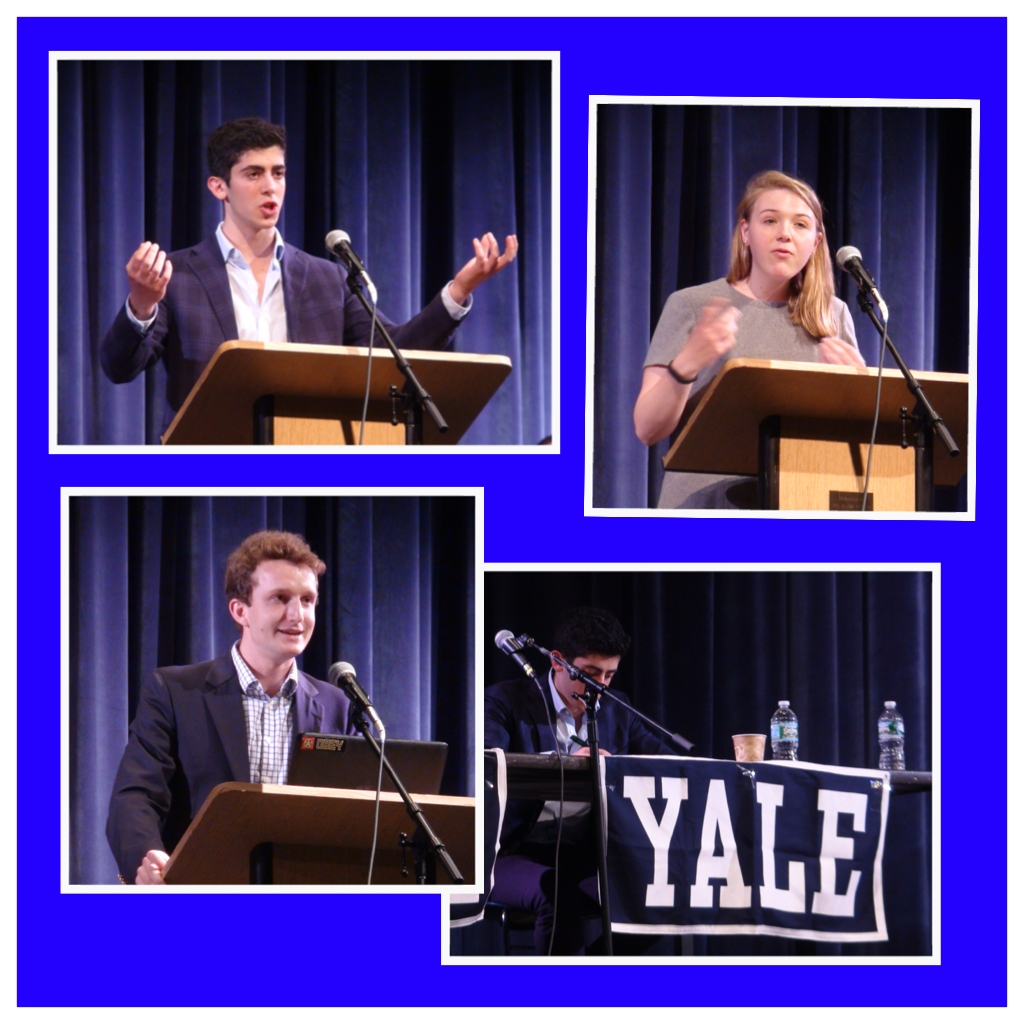
For Yale, Rye native Charlie Barton was joined by teammate Quinn Crawford '21.  Raymond Xu and Preston Johnston, both sophomores, represented Princeton. Martin Sklar, Princeton-Westchester's president and Debate Co-Chair acted as moderator of the event.  Yale also won the event in 2017 at Arsdley High School.  Princeton won in 2016.

Joshua Levin, Administrative Law Judge in New York State, and former Scarsdale mayor Jon Mark judged the event.

This year's event followed the traditional program, where high school teams follow and compete after the collegians are done.  Before they take the stage, the college debaters coach the high school students.  Horace Greeley faced off against Hackley before Blind Brook competed against Harrison.  Judges determined Harrison to be the final high school winner.

Horace Greeley was represented by Krishna Ramaswamy and Dorothy Low.  Zach Yusaf and Zara Yusaf debated for Hackley.  Adena Kibel and Aidan O'Neil were Blind Brook's debaters. The Harrison winning debaters were Rebecca Anderson and Giobanni Cutri, both juniors.

The annual Westchester debate is funded in part by the William Nightingale '53 Debate Fund.  Nightingale continues his two decades of involvement as a Co-Chair of the event.  YWAA board member Dana Sands '83 acts as Senior Chair of the event.

Yale debaters were selected as victors in 2014 and 2015. A team from Brown defeated Harvard and Yale teams in 2013.

Add caption


Sunday, October 14, 2018

Yale vs. Princeton in Debate, 2018

Debaters from Yale will meet their foes from Princeton at the 22nd annual Westchester Debate Competition in White Plains at the German International School on Friday, Oct. 26 at 7 p.m.              .

The competition will also include area high school teams, who will compete after the Yale-Princeton affair. Once again it is sponsored by YWAA and Princeton's Westchester alumni club. 

Yale gets a chance to defend its Westchester title after having defeated the Princeton group at Ardsley High School in 2017.   Blind Brook won the high school debate last year. Princeton defeated Yale at Ardsley in 2016. Yale took the title in 2015 in Armonk.

High school teams this year will include those from Blind Brook, Hackley, Harrison and Horace Greeley.

The competition, the prizes for which are funded in part from the William Nightingale '53 Debate Fund, includes topics in current events, politics and history.  Teams spar by delivering arguments in favor of or against the issue or question presented.

Ardsley has hosted the event in recent years, but this year's event moves to the German School. Byram Hills, the Hackley School, the Masters School and Blind Brook have also hosted the debate in the past decade.  

Yale and Princeton once again headline the night.  In other years, Yale's team has competed against squads from Brown and Harvard.  After the college students compete, they help coach the high school teams before they present. 

Nightingale and Dana Sands '83, YWAA board member, are Yale coordinators of the event. Martin Sklar is the Princeton coordinator.

For more about the history and tradition of the debate program, sponsored by YWAA, click YWAA-Debate.

               . 

Tuesday, November 7, 2017

Yale, Princeton Compete in Debate

Yale was able to recapture the debate crown from Princeton, a 2016 winner. (YWAA photos--Munguia, Mattison)
The annual Westchester Debate Competition, showcasing teams from Yale and Princeton, returned to Ardsley High School, Nov. 3. For a second straight year, area students, teachers, debate coaches, families, and alumni gathered eagerly, as teams took the stage to address political and social issues in the way of formal debate.

Yale won the college competition (the 21st annual event), seizing the collegiate crown after Princeton's win last year.  Blind Brook High School, a 2013 host for the competition, was named the winner of the high school competition, which included five other squads.

Dana Sands '83 and Bill Nightingale '53 acted as a Co-Chairs for the event and were joined by Princeton's Westchester alumni president Martin Sklar in organizing the debate program and a pre-competition dinner for competing students.

The format followed the conventional Westchester program, where Yale and Princeton debaters determined a topic before the competition began, sparred back and forth (point, counter-part, more statements and more rebuttals), and waited for judges (local officials) to announce a winner. 

High school teams, coached by the college students, followed and addressed such issues about whether the U.S. has an obligation to enforce immigration laws, whether colleges have an obligation to protect campuses from hate speech, and whether American citizens who opt not to vote should be fined.

Participating high schools included Byram Hills vs. Fox Lane, Ardsley vs. Blind Brook, and Rye Neck vs. Yonkers.  High school winners (from Blind Brook) received scholarships, funded in part from the William Nightingale '53 Debate Fund. 

Byram Hills hosted the event in 2015. Hackley School hosted in 2014.

(Participants and debate rosters will follow.)

Ardsley High School again hosted the Westchester Debate Competition, Nov. 3, 2017
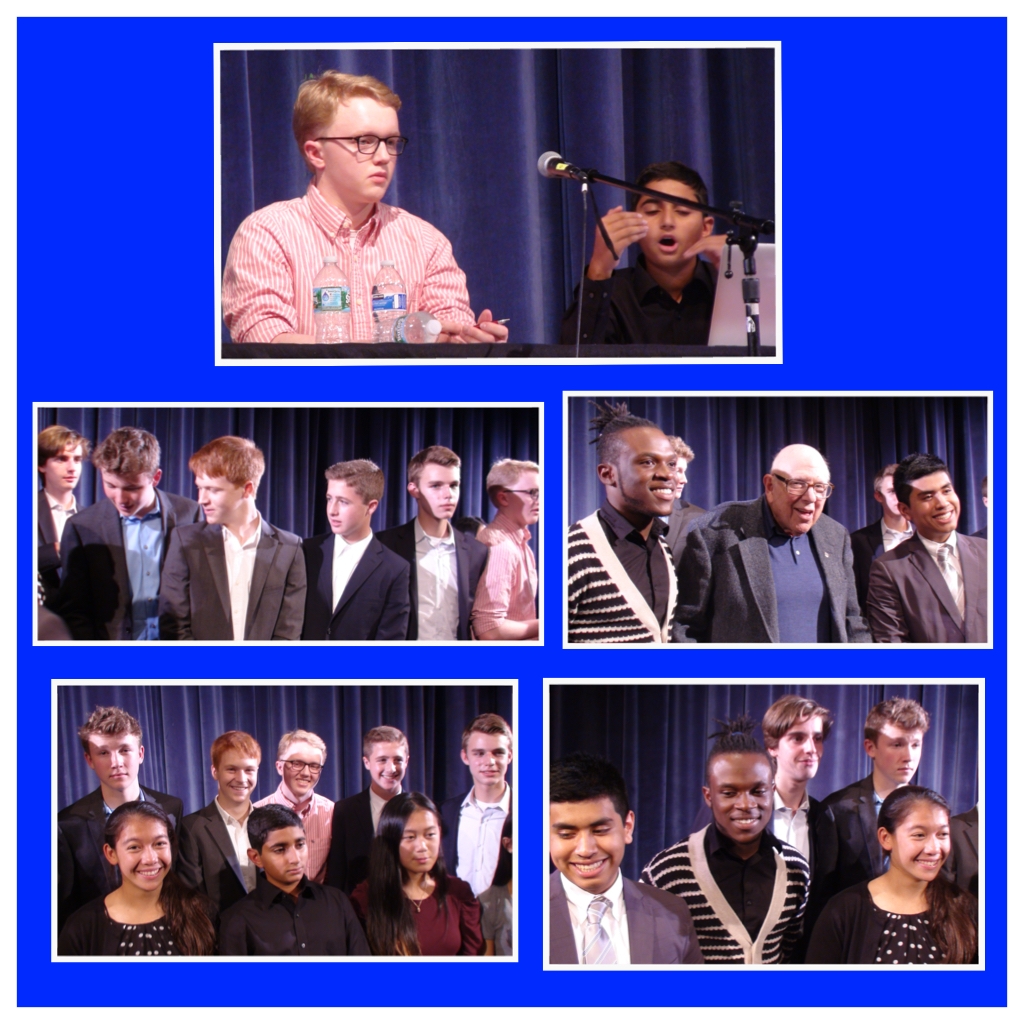
Winners from Blind Brook High School joined the judges after the high school competition.  All participates gathered at the stage for a final photo. (YWAA photos--Munguia, Mattison)


Debate students from Yale, Princeton and six high schools met each other at a dinner in the Ardsley school library. (YWAA photos)


Debate Co-Chair Bill Nightingale '53 (top, R) greeted guests at Ardsley and thanked the school and other organizers. (YWAA photos)

Tuesday, October 17, 2017

Yale-Princeton Debate, Nov. 3 in Ardsley

Westchester Debate continues for the 21st year in Ardsley, Nov. 3 (YWAA photos)
When college and high school debate squads spar on stage this year, what will be the topics around which they craft shrewd arguments?

With a U.S. presidential election last year's news, there still won't be a shortage of political issues and subjects to address before a typical audience of hundreds of students, parents, and debate enthusiasts:  Climate change, health care, tax policy, nuclear warheads, sustainable-energy initiatives, divisive politics, or perhaps national-anthem gestures at football games. 

The 21st annual Yale Westchester Debate Competition returns to Ardsley High School, Friday, Nov. 3,  2017. Once again, the Yale Debate Team will start the night at 7 pm with a showdown against Princeton, last year's winner at Ardsley. Scarsdale's Michael Bogarty '19 debated for Yale in 2016.  Yale won the competition in 2014 and 2015.  Brown triumphed in 2013, when it joined Yale and Princeton as a competing squad.

The college debaters this year will be followed by six Westchester high-school teams. The collegians will also help coach the high-school students on their topics and arguments before they debate. If tradition rules, the topics among the high-schoolers won't be any less controversial or complicated. In 2016, judges pronounced Horace Greeley High School as the winner.

The annual Debate is sponsored in part by YWAA's William Nightingale Fund, which honors YWAA board member Bill Nightingale '53.  Nightingale returns as event co-Chair and emcee. 

Ardsley High School, after filling its auditorium last year with home-school fans, teachers, and students, as well as area Yale and Princeton alumni, was invited to host again. The competition in recent years has been hosted by high schools from Byram Hills, Rye Brook, Hackley, and the Masters School.

Yale alumni, family, friends and those interested in hearing the younger generation think out loud about some of the toughest issues of the times are invited.  There is no charge or fee.


Debaters from Yale, Princeton and Brown compete during the 2014 Westchester competition at Hackley School. (YWAA photos)

Thursday, November 10, 2016

Debate Duel in Ardsley

Ardsley High School was the host for the 20th annual Westchester Debate Competition, Nov. 4. The Yale squad faced Princeton. Both teams were asked to debate a topic tied to free trade and free markets. (YWAA photos)

Another year meant another close call with Princeton declared the winner for 2016. (YWAA photos)
This could have been a debate that evokes memories of 2016 Trump-Clinton showdowns that melted into prime-time fury. But it wasn't. It was a more civil, more pleasant form of debate. It was Yale vs. Princeton at the Westchester annual debate competition, sponsored by YWAA and Princeton-Westchester, held at Ardsley High School, Nov. 4.

The fury, intensity, and spark were there. The debaters fiercely challenged statements, points of view and rationale.  Yale debaters eyed their Princeton foes and stood up to disagree.  Princeton debaters sometimes ignored Yale debaters when they requested to rebut a point. 

In the end, unlike the better known president-candidate debaters on a national stage, Yale and Princeton were respectful of each other, shook hands and hugged each other while they waited for judges to deliberate.

This year's competition, the 20th annual, was close, as many of them are. The Ardsley auditorium was filled with students, parents, teachers and a handful of Yale alumni (over 200 in the room).  Judges grasped to make a decision and declared Princeton the winner (after Yale's victory over Princeton last year). 

This year's topic was likely addressed in more detail than the showings from the current year's presidential nominees.  Yale and Princeton debaters analyzed the topic:  Are markets and economies better with the erosion of borders?  And they examined the pros and cons of free-trade agreements and tariffs as if they were economics graduate students.

Sophie Hyeon Park '19 of Seoul, Korea, and Michael Bogarty '19 of Scarsdale represented Yale.  The Princeton team included An Lahn Le and B. Srinivasan.

Back and forth they went. They discussed protectionism and globalization. They pondered the economies of India, Cambodia, Viet Nam, and China. Yale was asked to argue against free trade. Princeton was assigned the other side.

Finally the final gong went off to end the debate, and judges (local officials Delores Brathwaite, Walter Rivera, and Joshua Levin, who returned for the third straight year) rendered the decision.

Following the Princeton win, six high-school teams took the stage. They, too, were asked to address brain-churning, topical issues:  (a) Should merit-based scholarships replace need-based aid in colleges? (b) Is a multi-party political system better than a two-party system? (c) Should the government support human exploration in space?

Host school Ardsley, cheered on by dozens of fellow students, competed against the Masters School.  Hackley, which hosted the competition two years ago, faced Horace Greeley.  Fox Lane debated Yonkers-Lincoln.  Judges pronounced Greeley the overall high-school victor.  Winners (Sophie
Saremsky and Michelle Tong) and their school received scholarships, funded by the Nightingale Debate Fund.

YWAA board member Bill Nightingale '53 himself was once again the debate's co-Chair, along with YWAA board member Susan Kaminsky '86 and Princeton-Westchester's president Martin Sklar.  Richard Bradley '86 was the moderator for the third year in a row. 
Bill Nightingale '53 (above), a Co-Chair of the event, greeted the audience before the evening debate. Below left, moderator Richard Bradley '86 explains the debate rules to the audience.

Debaters from each team, one by one, took the podium to explain their points of view or rebut the arguments from the other side. Below, members of both teams congratulated each other and chatted about college life. (YWAA photos)

YWAA president Tim Mattison '73 (above) congratulated the Yale squad for its efforts. (YWAA photos)
The judges conferred and, minutes later, declared Princeton the 2016 winner.  High school debaters (above) took the stage afterward. (YWAA photos)
Above, Martin Sklar (top,L) of Princeton-Westchester greets the college debaters.  Participants in the high school debate gather on the Ardsley stage.  The trio of judges (Delores Brathwaite, Joshua Levin and Walter Rivera) returned for the third consecutive year.

Debaters from all high schools joined event organizers Bill Nightingale '53, Susan Kaminsky '86 and Princeton alumnus Martin Sklar on the stage after the competition.


Wednesday, October 26, 2016

Yale-Princeton Debate in Ardsley, Nov. 4

Yale and Princeton will be the featured college teams at the 20th annual Westchester debate competition Friday, Nov. 4, 2016, sponsored by YWAA and Princeton's Westchester alumni group. For the first time, Ardsley High School will host the event, which features, too, a high-school competition. The college debaters will kick off at 7:15 pm.

Yale alumni in the region are invited to attend. There is no fee. Richard Bradley '86 returns for the third year in a row as moderator.

Yale has won the last two competitions, held at Hackley School and Byram Hills High School. Brown won the 2013 competition, hosted by Blind Brook High School in Rye Brook.

The format calls for the college teams to spar first. Earlier in the evening, debaters will be told the topic and will be instructed which side to take--for or against.  Topics in the past years have been tied to politics or global affairs and aren't easily resolved in a hour's showdown. In the past two years, the collegians were asked to debate the U.S.'s engagement with ISIS and the possibility of slavery reparations. 

In the format, Yale and Princeton will present their initial arguments and then have the chance to rebut, follow up and contest the views of the opposing side. 

Judges, who in the past two years have been Westchester attorneys and judges, will assess the arguments and pay attention to delivery, style, logic, and conviction. They will choose a winner and often take a moment in the end to provide for both teams constructive criticism.

Six high-school teams will follow. In past years, the college teams assist the students in preparing their arguments.  For the local students, the topics are no less challenging.  Last year, high-school squads were asked to debate whether there should be an increase in the minimum wage or whether narcotic drugs should be decriminalized.

The annual debate competition is funded in part by the William Nightingale '53 Fund.  Nightingale continues as one of the event organizers, along with Susan Kaminsky '86 and Princeton alumnus Martin Sklar.


Debaters from Yale and Princeton (above) took the podium at Byram Hills High School during the 2015 competition. (YWAA photos)

Thursday, September 29, 2016

Debate Time

YWAA is planning its fall debate competition, the 20th annual, featuring teams from area high schools and highlighting college teams from Yale and other Ivy League schools.

Debate Night, 2016, is tentatively scheduled for Friday, Nov. 4.  Ardsley High School, which competed last year at Byram Hills School, has agreed to act as host school.  (In recent years, Hackley School and Blind Brook have also been hosts.) Competition details, including the roster of high-school and college teams, will follow.

Last year, Yale defeated Princeton. At Hackley in 2014, the Yale squad defeated Brown and Princeton.

Click DEBATE for highlights of debates in 2013-15.  The annual competition is funded in part by the William Nightingale '53 Fund.  Nightingale once again is Co-Chair of this year's event.


In 2014, the Yale debate team defeated squads from Princeton and Brown at Hackley School in Tarrytown. (YWAA photos)

Tuesday, November 10, 2015

Yale, Princeton Spar in Armonk

Yale and Princeton debaters were asked to travel in time to the period of Reconstruction, 1866, to address slavery reparations. Yale was represented by Sam Feinburg '18 (top, L) and Walker Mayer '18 (bottom, L).  Carolyn Liziewski (top, R) and Ben Ulene of Scarsdale represented Princeton. (YWAA photos)
Each year before the annual Westchester debate competition that pits Yale against other Ivy League squads, student participants arrive at the venue without any idea what the topic will be. They brace for any subject matter--from politics to history, from social issues to science.  They hope that experience, logic, swift thinking, quick wit and a rapport with judges will propel them to victory.

For this year's competition, Yale defended its Westchester title from a year ago and faced off against Princeton Nov. 6 in Armonk.  Now in its 18th year, the event was sponsored by YWAA, Princeton's alumni club in Westchester and Byram Hills High School, which also acted as host site. The event is funded in part by YWAA's Bill Nightingale '53 Fund, which honors Nightingale's long-time leadership in organizing, planning and executing the event.  

When the Yale and Princeton participants entered the building, little did they know they were about to address a controversial question, take sides, and present their views to an audience of Westchester residents, teachers, students and other Yale and Princeton alumni. They were asked to take a trip back into history, the U.S. just after the Civil War, 1866, during Reconstruction:  

Should newly freed slaves receive land grants from the U.S. Government (40 acres) as compensation for enslavement?

The Yale team of Sam Feinburg '18 and Walker Mayer '18 was asked to argue in favor. Princeton, which included Ben Ulene, a sophomore from Scarsdale, and Carolyn Liziewski, a sophomore from Portland, Me., was asked to argue against such legislation. 

Richard Bradley '86 returned as moderator and posed the question to the audience. With Walter Rivera, a Greenburgh Town Court justice, and Joshua Levin, a White Plains attorney, acting as judges, the debaters commenced, sparring back and forth for the next hour.  Rivera was a judge in last year's competition, when Yale defeated teams from Princeton and Brown. 

Event organizer Bill Nightingale '53 (top, L) was the evening's emcee. Greenburgh Town Court justice Walter Rivera (top, R) returned to judge the competition.  Richard Bradley '86 (bottom, L) returned as moderator. (YWAA photos)

Yale's Mayer, a Providence, R.I., native, launched the arguments for the evening. He stated freed slaves were entitled to land grants because of "trillions of dollars of compensation withheld." Liziewski from Princeton countered that the North couldn't "unilaterally blame the South" and the South couldn't be solely responsible for the injustices of the time.  She argued that the property granted to slaves would be seized eventually. She proposed other solutions:  voting rights, property protection, and education. 

Feinburg of Yale, who hails from London, rebutted and argued that freed slaves were entitled to some form of economic power and not "some limp appeasement" in the form of special programs recommended by Princeton.

Princeton's Ulene took his turn to argue that land grants would fail because they would rely on feeble Southern law enforcement to ensure property wouldn't be repossessed. He questioned how social mobility could be achieved from property gifts. 

Debaters on both sides, while at the podium, argued fiercely, loudly, vigorously. Judges Rivera and Levin listened closely, nodded when they understood points, and took many notes.  

No issue of such magnitude or impact could be resolved in an hour, yet judges were forced to render a final decision, a victor for the night.  After they deliberated, they pronounced Yale the winner and explained how both teams presented strong statements. But Yale edged its foe based on convincing arguments and a connection to and rapport with the judges.
Judges pronounced Yale the winner, but applauded the arguments and debating skills of both teams. (YWAA photos)
True to tradition, high-school teams took the stage next.  Six teams (two at a time) from Ardsley, Lincoln (Yonkers), Byram Hills (Armonk) (two teams), Rye Neck, and the French-American School competed. 

Like their collegiate counterparts, they, too, didn't know ahead of time the topics they would encounter. They, too, were required to prepare bullet-point arguments to questions that sometimes take lawmakers years to resolve, often in vague, watered-down solutions.  

High-school participants were asked to debate: 

(a) Should all forms of narcotic drugs be decriminalized?  
(b) Should the U.S. and its military force act as the protector and police force for all the world?
(c) Should the Federal Government enact legislation to require all states to pay a minimum wage of $15/hour?

Just like their college brethren, the high-school students marched one by one to the stage front to convince parents, classmates and judges their side was the right side.  

The Byram Hills team of Will Amorosana and Arjun Goyal (top) emerged as the high-school victors. High-school participants convened on the stage afterward to receive coaching and oratorical advice from the judges. (YWAA photos)
In the end, the judges picked one winner among the six teams. But first, they called forth all team members to coach them, showing them how to win over debate judges in the way a shrewd lawyer wins over a jury in court and telling them that how the argument is presented is as important as the logic and flow of statements. They advised them to pause and not rush or spew statements. 

Impressed with the conviction in which they spoke, they pronounced the Byram Hills team of Will Amorosana and Arjun Goyal the high-school winner.  The students and the school received prizes, funded in part from the Nightingale Fund.

Debate organizers included Princeton alumnus Martin Sklar and YWAA board members Nightingale and Susan Kaminsky '86.  

Harvard, a participant in the competition in previous years, was absent this year. With Yale and Princeton vying in a spirited discussion and shaking hands afterward, the Cantabs weren't missed.

Princeton's Ben Ulene of Scarsdale (top, L) presented his case. The Ardsley High School team prepared on the sidelines (top, R). Yale and Princeton debaters shared college stories beforehand (bottom, R). (YWAA photos)  

Ardsley High School debaters Gabriel Golombek and Joshua Nobel listened to opponents (top, L). Rye Neck High School's Olivia Dunne responded to arguments (top, R), (YWAA photos)

Bill Nightingale '53 (top), after the competition, praised college and high-school debaters for giving strong performances. Event organizers from Yale and Princeton (middle) gathered on the stage afterward. Richard Bradley '86 speaks to Yale winners WalkerMayer '18 and Sam Feinburg '18 (bottom, L). (YWAA photos)

Byram Hills High School participants prepare before the start of competition (top, L). Joshua Levin and Walter Rivera (bottom, R) judged both the high-school and college debates. (Zachary Milewicz photos)